Offline Bio-Potentials Interface

Myco-Communicator

v1.2 — POST FULL TECHNICAL REVIEW

A portable, offline bio-sensing field instrument engineered to bridge the gap between human technology and the electrical language of fungal networks. Not sonification — genuine scientific recording, stimulation, and correlation.

8-channel recording galvanic stim isolation IP65 field enclosure WiFi + BLE + microSD
ESP32-WROOM-32E 8× INA333 INSTRUMENTATION AMP ADS1115 16-BIT ADC MCP4921 12-BIT SPI DAC ADuM1401 DIGITAL ISOLATOR BME280 ENVIRONMENTAL SENSOR ASA 3D-PRINTED IP65 ENCLOSURE Ag/AgCl PROBE ELECTRODES SPLIT AGND/DGND/SGND PLANES ESP32-WROOM-32E 8× INA333 INSTRUMENTATION AMP ADS1115 16-BIT ADC MCP4921 12-BIT SPI DAC ADuM1401 DIGITAL ISOLATOR BME280 ENVIRONMENTAL SENSOR ASA 3D-PRINTED IP65 ENCLOSURE Ag/AgCl PROBE ELECTRODES
01 / The Challenge

Why this instrument exists

Fungi communicate across vast networks using electrical impulses — action-potential-like spikes documented by researcher Andrew Adamatzky at the University of the West of England. These signals travel along hyphal networks, respond to light, moisture, chemical gradients, and temperature, and occur in spike trains statistically similar to neural activity.

The "plant music" projects you may have seen are purely sonification — mapping spike frequency to MIDI notes. No one has systematically tested whether spike patterns are reproducibly correlated with environmental events, or whether a network responds differentially to injected signals. That is exactly what the Myco-Communicator is built to test.

The Hypothesis

If spike patterns are correlated with environmental events AND the network responds differentially to varying injected pulse patterns, there is a basis for a primitive signalling model. This board is the instrument to test that over long-duration field recordings.
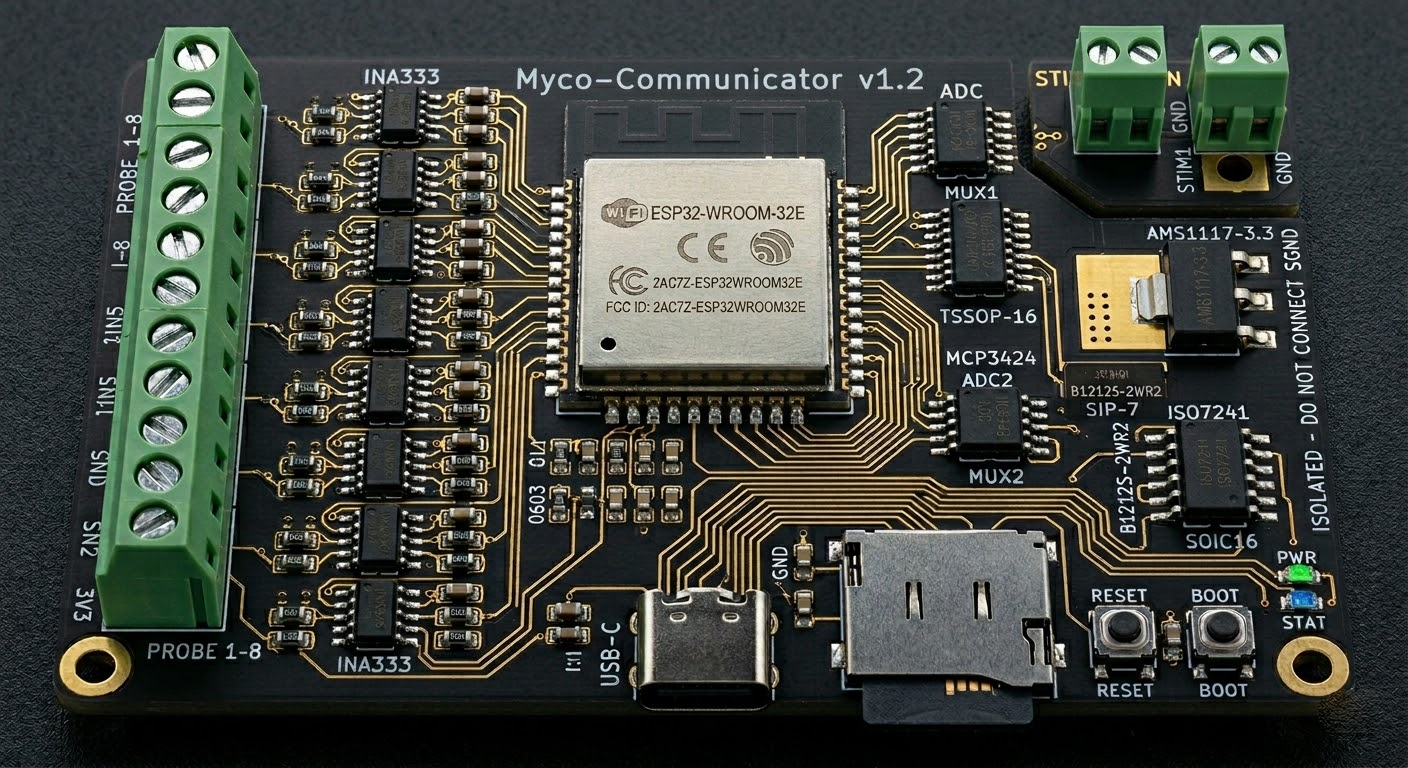
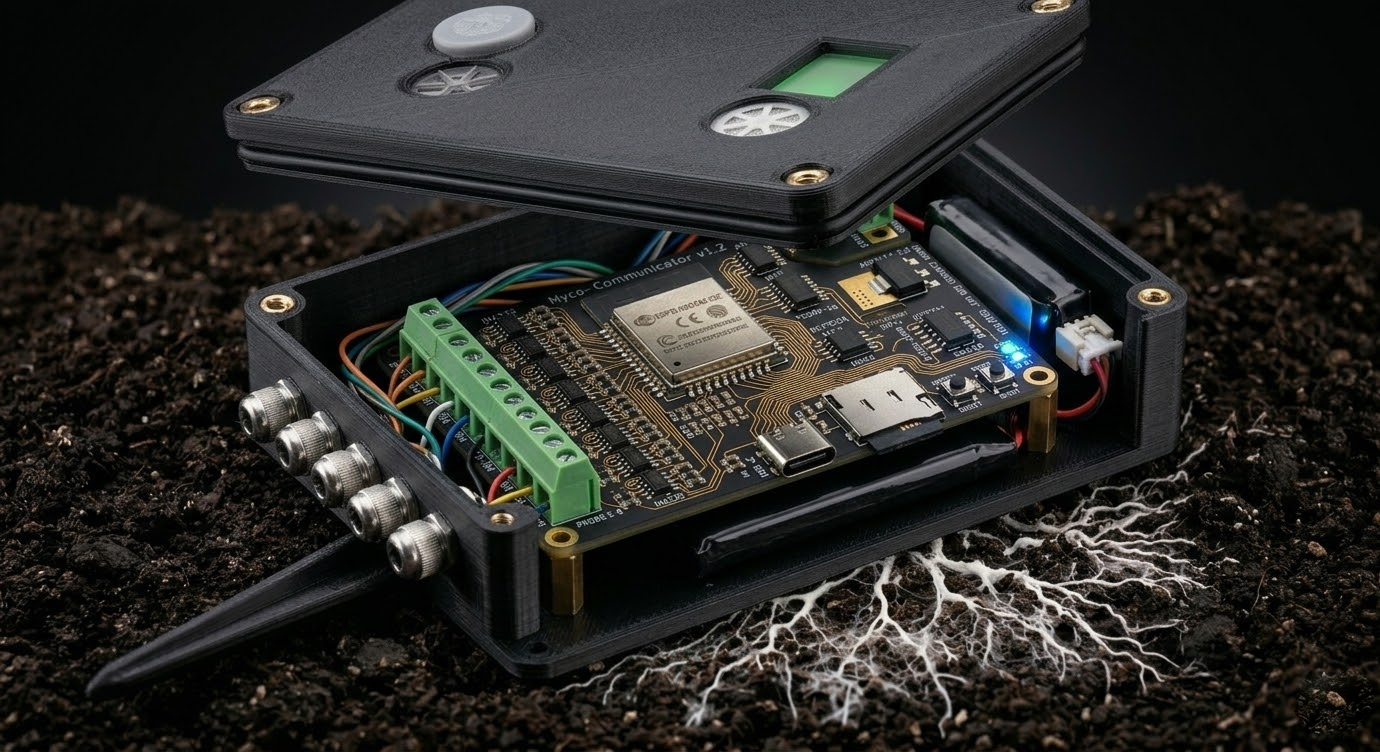
Myco-Communicator V1.2 PCB
02 / Signal Architecture

The recording chain

Every component decision made to serve signal integrity first. Mycelium bioelectrical signals are in the 0–2 mV range — roughly 1/1000th the amplitude of a heartbeat.

Recording path

Ag/AgCl probe pair
1kΩ + BAV199 ESD
INA333 ×200 gain
RC LPF 25 Hz
HC4051 mux
ADS1115 16-bit ADC
IIR 60 Hz notch
microSD + WiFi

Stimulation path — galvanically isolated

ESP32 SPI
MCP4921 12-bit DAC
ADuM1401 isolator
B0305S-1W DC-DC
OPA333 buffer
10kΩ limit → stim probes

↑ SGND is fully floating — electrically invisible to the recording chain

Why INA333 before mux?

Placing the mux before the amplifier would cause mux leakage current to be amplified ×200, corrupting every channel. One INA333 per channel — the mux only switches clean, low-impedance amplified outputs.

Why galvanic isolation?

Without isolation, stimulation pulses create a large common-mode voltage that saturates the recording amplifiers. You'd be completely blind to the network's response — the most important measurement window.

Why digital IIR notch?

A hardware notch at 60 Hz needs tight-tolerance C0G capacitors that don't exist at 0402 size. X7R capacitors drift with temperature, making the notch slide and miss. A firmware IIR filter is perfectly stable.

03 / Hardware Architecture

Technical specifications

RECORDING CHAIN
Input channels8 differential pairs
Amplifier8× INA333, ×200 gain
Full-scale input±10 mV before clipping
ADC resolution16-bit (ADS1115)
Sample rate~100 SPS per channel
Hardware filter2-pole RC, fc ≈ 25 Hz
Software filterIIR notch 60 Hz
Input protection1kΩ + BAV199 ESD clamp
STIMULATION + SYSTEM
DAC resolution12-bit MCP4921 SPI
Stim output range0–3.3V, max ~165 µA
Stim isolationADuM1401 + B0305S-1W
MCUESP32-WROOM-32E
WirelessWiFi 802.11 b/g/n + BLE 4.2
EnvironmentalBME280 T/RH/P
StoragemicroSD CSV + WiFi JSON
PCB75×55mm, 2L FR4, ENIG black

Custom PCB & Noise Architecture

The V1.2 board uses split ground planes — AGND for the analog section, DGND for digital, and a fully isolated SGND for the stimulation circuit. These planes meet at a single star point near the ADC. A ferrite bead on the AVDD rail prevents digital switching noise from contaminating sensitive microvolt readings.

C0G/NP0 dielectric capacitors (0603 package) are used on the filter network — the only dielectric with the temperature stability required for precision filtering at these frequencies.

Field-Ready Power System

MCP73831 LiPo charger via USB-C with a DW01A + FS8205 hardware protection circuit preventing over-discharge, over-charge, and reverse polarity. The AP2112 LDO is specified in SOT-223 package — not the smaller SOT-23-5 — to provide thermal headroom for ESP32 WiFi current spikes up to 500 mA.

Battery life on an 800 mAh LiPo: ~3–5 days (SD logging only), ~18–24 hours (WiFi streaming active).

Dual-Input Sensor Hub

Subterranean network (CH1–CH8)

Ag/AgCl electrodes inserted 20–40 mm into mycelium substrate. Differential pair per channel with 5–15 mm within-pair spacing. ER308L stainless steel used as an alternative for initial prototyping — higher noise floor but robust in damp soil. A single large-area Ag/AgCl reference electrode ties to AGND for common-mode rejection across all channels.

Fruit body / cap surface

Non-invasive 3M Ag/AgCl floating ECG electrodes on the fruiting body caps. Surface probe pairs rest on or just below the substrate surface — no insertion required. Dedicated channels allow simultaneous comparison between subsurface network activity and surface cap activity during the same event.

Myco-Communicator IP65 Enclosure
04 / Field Enclosure

IP65 soil-stake enclosure

The Myco-Communicator deploys directly into soil via an integrated hollow stake. The enclosure is 3D printed in UV-stable ASA plastic — not PLA, which becomes brittle in outdoor UV within weeks — with a 95 × 70 × 42 mm body sitting roughly 30 mm above ground level.

Hollow wire conduit stake

180 mm stake with 6 mm internal channel. All 18 probe wires route through the stake body into the soil — protected from UV, mechanical damage, and wildlife.

9× PG7 IP68 cable glands

8 recording pairs + 1 stimulation pair. Each gland compression-seals the wire jacket. Side wall penetrations only — bottom is solid stake.

Gore-Tex M12 vent + EPDM O-ring

The BME280 breathes real ambient air through a Gore-Tex membrane vent in the lid — IP67, allows pressure and humidity through while blocking liquid water. EPDM O-ring lid seal rated for −40°C to +120°C.

Waterproof USB-C charging port

Panel-mount USB-C with rubber cap on the right wall. Charge the LiPo without opening the enclosure and breaking the IP seal.

05 / Probe Deployment

How probes are placed

18 wires total fan out from the hollow stake into the substrate — 16 recording wires (8 differential pairs), 2 stimulation wires, plus 1 reference electrode.

stake ch1 ch2 ch3 ch4 ch5 ch6 ch7 ch8 stim+ stim− ref (AGND) dense zone colony boundary

top-down view · not to scale

CH1–CH8 — Recording pairs

8 differential pairs arranged in concentric rings. CH1–CH2 inner ring (80–120 mm from stake) capture strongest baseline signal. CH3–CH6 middle ring (130–180 mm) track propagation. CH7–CH8 outer ring (180–220 mm) catch peripheral activity. Each pair's + and − electrodes sit 5–15 mm apart, oriented radially.

STIM+ / STIM− — Stimulation pair

Placed on opposite sides of the colony, ~300 mm apart. Creates a current path crossing the entire network. On the fully isolated SGND circuit — electrically invisible to the 8 recording channels. Max 165 µA, safe for biological tissue.

REF — Reference electrode

Single large-area Ag/AgCl electrode tied to AGND. Provides a common quiet reference for all 8 recording channels, reducing common-mode noise across the entire array. Inserted ~30–40 mm depth at bottom-centre of the colony.

SPACING GUIDE

Pair gap (+/−):5–15 mm CH1–CH2 inner:80–120 mm CH3–CH6 mid:130–180 mm CH7–CH8 outer:180–220 mm Stim separation:~300 mm
06 / Software Ecosystem

Three operating modes

The firmware hosts a BLE 5.0 server, sampling analog data continuously and streaming to a custom React Native app — completely off-grid and offline.

Mode 01

The Eavesdropper

Real-time scrolling graphical plotter visualising both slow environmental voltage waves and rapid nerve-like action potentials across all 8 channels simultaneously.

Mode 02

The Stimulator

Reverses the flow — send gentle, modulated arbitrary waveform pulses back into the substrate via the isolated stimulation probes and watch the network's response across all recording channels.

Mode 03

Sonification

Translates raw voltage data into live audio — electrical spikes and waves mapped to musical pitch and sustained drone notes. The closest thing to hearing the network speak.

07 / Research Protocol

Four-phase experiment

A systematic, reproducible protocol designed to move from observation to communication hypothesis testing.

WEEKS 1–2 Baseline

Phase 1 — Passive observation

Record continuously, no stimulation. Establish baseline spike statistics per channel — mean spike rate, amplitude distribution, inter-spike interval histograms, burst patterns. Correlate with BME280 weather data. Tune mux settling delay. Identify most active channels.

WEEKS 3–4 Repeating Stimulus

Phase 2 — Scheduled stimulation

Introduce a single daily repeating pulse at a fixed time: 1 Hz square wave, 200 mV, 5 seconds. Record all 8 channels for 30 minutes post-stimulation. Compare pre- and post-stimulation spike statistics — rate change, latency to first response, decay time.

WEEKS 5+ Parameter Variation

Phase 3 — Systematic variation

Vary one stimulation parameter at a time — frequency, amplitude, duration, waveform shape. Hold all others constant. Run each condition for minimum 5 days before changing. Compare response patterns between conditions to look for differential responses.

ONGOING Conditioning Test

Phase 4 — Anticipatory behaviour

Does the network begin showing increased spike activity in the minutes before a scheduled stimulation event, after enough repetitions? Does the response pattern change with extended repetition? This is the most scientifically consequential phase — evidence of network-level conditioning would be significant.

Ecosystem Synergy

The catalyst for Weatherything

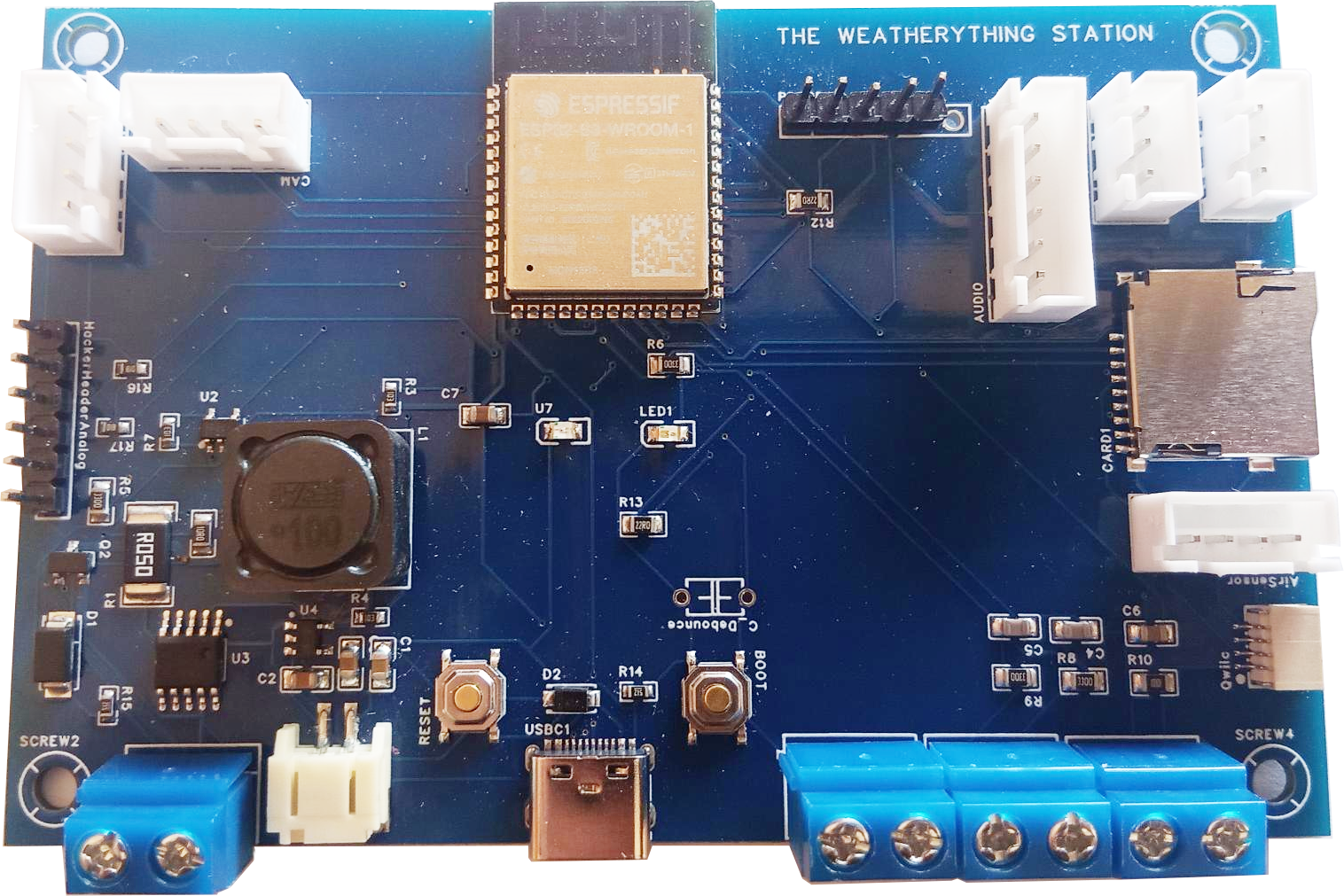
To decode the language of fungi, we needed context. We needed to know exactly which environmental factors were triggering the electrical action potentials we were recording — not delayed API weather data, not generic off-the-shelf stations that fail off-grid. We needed hyper-local atmospheric data, soil temperature, and moisture directly at the source, running alongside the Myco-Communicator.

This strict field requirement became the genesis of the Weatherything Station — what started as a dedicated environmental companion quickly evolved into a full multi-purpose open-source IoT platform pushing the ESP32 architecture to its limits.

Explore the Weatherything Station
Weatherything Station
08 / Roadmap

Machine learning integration

The next phase integrates an offline TensorFlow Lite model directly into the app to categorise the electrical spikes — cross-referencing the 50 known electrical "words" (repeating spike clusters) identified in published mycological research.

Drawing on Adamatzky's documented spike vocabulary, the model will build a localised database of environmental reactions — allowing us to definitively observe when a network is experiencing drought stress, physical injury, weather front pressure changes, or food source detection. The long-duration field recordings from Phase 1 become the training dataset.

spike classification TensorFlow Lite offline 50-word vocabulary environmental correlation

Expand the network

Actively looking for mycologists, bio-acoustics researchers, and embedded software engineers to collaborate on the TensorFlow Lite data modelling phase of this project.

Reach Out to the Lab