A grab-and-go, roof-mounted automotive sensor ecosystem that utilizes dual-spectrum optics and local Edge AI to give drivers "x-ray" visibility in extreme weather conditions.
Whether navigating severe maritime whiteouts, torrential rain, or pitch-black rural roads, standard automotive headlights are often insufficient. They reflect off fog and snow, creating a blinding wall of white, leaving drivers completely unaware of massive hazards like wildlife or stalled vehicles until it is too late.
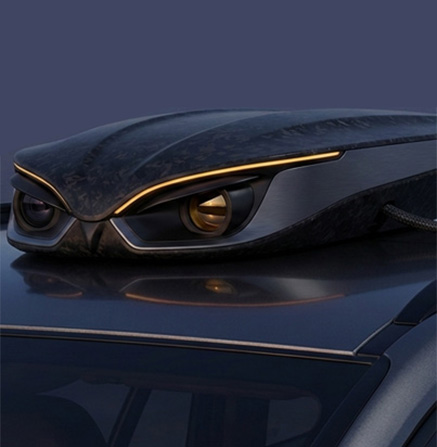
The Road Owl is engineered to "See The Unseen." By bridging the gap between a physical external sensor array and a custom digital UI inside the cabin, we allow drivers to identify thermal signatures and physical obstacles hundreds of feet before they enter headlight range.
This raw footage demonstrates our AI detection model in action. Right now, the Road Owl is still a fledgling. For this initial proof-of-concept, we are running our neural network on basic, off-the-shelf hardware housed inside a standard plastic box with a recessed lens.
We put this early prototype up against the worst possible conditions: low resolution, a lens actively accumulating rain and snow, and a dark, wet road at 76 km/h. As the video shows, the system easily filters out a pedestrian on a clear highway without throwing a false alarm. Then, our young AI pierces through the nasty weather to spot a hidden hazard—a dog beside the road.
The Engineering Takeaway: Even with severe hardware limitations, the Road Owl recognized an anomaly at 245 feet, giving the driver a massive 3.5-second warning to react. If our software can learn to see this clearly using basic components, imagine what the fully grown Road Owl will achieve when we deploy our custom board featuring "two eyes"—a top-tier dual-spectrum array.
After successfully validating the complex hardware-to-software pipeline in our initial Proof of Concept, we are actively engineering the commercial-grade prototype.
Upgrading from our initial architecture, Phase 2 integrates an NVIDIA Jetson Orin Nano. The core detection model has been rigorously trained on over 16,000 thermal images of wildlife and animals, allowing the system to accurately identify hazards in milliseconds without relying on cloud latency.
Featuring a custom board integrating a high-fidelity InfiRay 384x288 thermal core to detect heat signatures through snow and fog, running alongside a low-light Sony STARVIS 2 night vision sensor for standard optical clarity.
The hardware is housed in a sleek, aerodynamic, and ruggedized carbon-fiber shell. It is engineered to withstand extreme winter elements, freezing rain, and high highway wind resistance.
Head over to our dedicated consumer website to see the mobile app interface, view real road-testing footage, and learn how to acquire a Road Owl for your vehicle.
Visit RoadOwl.caInterested in the underlying Edge AI architecture? We are seeking hardware investors and technology partners for Phase 2 manufacturing.
Reach Out to the Lab