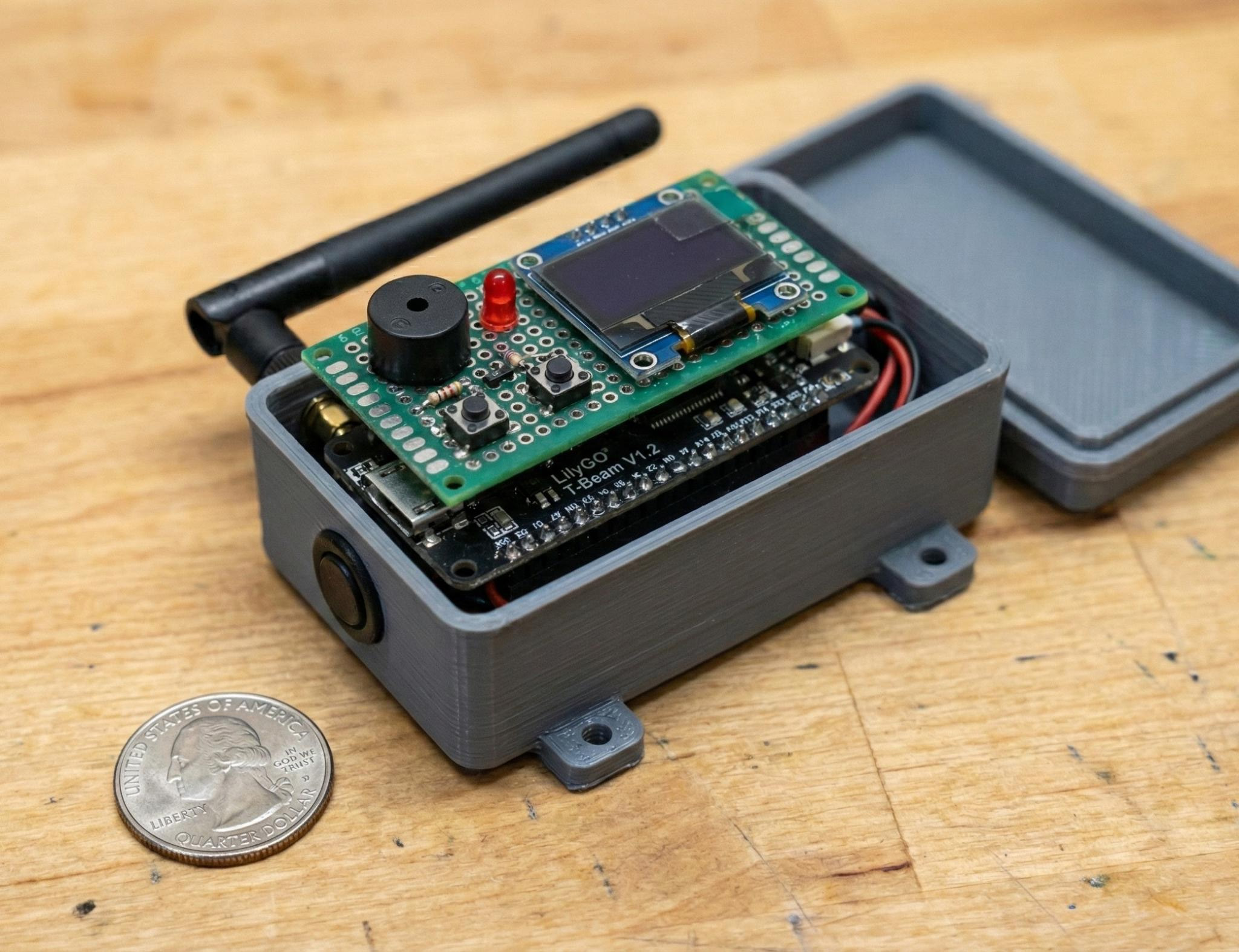
A custom-engineered, edge-computing geofencing and Long-Range (LoRa) telemetry system designed to entirely remove the dangerous dependencies on cellular data networks and monthly cloud subscriptions.
The inspiration for this project is deeply personal. I live off-grid in Nova Scotia with absolutely zero cellular reception. In this environment, commercial GPS pet trackers are completely useless.
Living in the woods comes with real hazards. When my dog, Sasha, was young, she once bolted deep into the freezing winter woods after being spooked by a snowblower. On a separate, terrifying occasion, she actually became trapped in a coyote snare.
While I was thankfully able to track her down and rescue her both times, those experiences exposed the fatal flaws in modern pet tech. Bulky collars snag on brush, batteries die rapidly in the cold, and without cell service, you are completely blind.
I engineered S.A.S.H.A. so that no owner living off the grid ever has to feel that helplessness.
Built on the low-power ESP32 architecture of the LilyGO T-Beam, the core electronics are housed in a rugged, bespoke 3D-printed enclosure designed to mount seamlessly to a tactical canine harness.
The device operates as a node on a decentralized Meshtastic network using a 915MHz LoRa radio. It transmits real-time location data entirely off-grid, providing up to a 3-kilometer tracking radius without ever pinging a cell tower.
Unlike market trackers that send coordinates to a smartphone to calculate boundaries, S.A.S.H.A. stores custom property coordinates onboard. It utilizes a Point-in-Polygon algorithm to evaluate containment locally.
Equipped with environmental sensors to detect dangerous temperature drops. An onboard gyroscope monitors for contextual emergencies based on the active mode (e.g., "Walking Mode"). It triggers instant alerts if it detects violent thrashing—indicating a snare or attack—or if the dog remains unnaturally stationary for too long in the woods.
Commercial containment systems rely on subscriptions, cell service, and archaic physical constraints that pose safety risks to the animal. We engineered S.A.S.H.A. to bypass these flaws.
Leading market collars cost hundreds of dollars upfront, and then completely disable their GPS tracking unless you pay a mandatory $10-$15 monthly subscription fee.
Once you own the hardware, it is yours. Because S.A.S.H.A. utilizes open radio frequencies (LoRa) to transmit data directly to your receiver, there are zero monthly fees and zero reliance on corporate servers.
If a dog gets caught in a snare or trap in the deep woods, traditional GPS trackers only show their location—they don't tell you the dog is in life-threatening distress.
S.A.S.H.A. uses an onboard gyroscope to monitor motion contextually. If it detects violent thrashing, or if the dog remains unnaturally stationary for too long during "Walking Mode," it transmits an instant emergency SOS alert.
Most trackers only tell you where your dog is, not what they are experiencing. In harsh winter conditions, a lost dog can quickly succumb to the cold before you realize the urgency.
The device is equipped with environmental sensors that actively monitor ambient conditions. If the temperature suddenly drops to dangerous levels, the system alerts the owner, adding critical context to the rescue effort.
Commercial devices rely on cellular signals to ping cloud servers to calculate boundary breaches. In rural areas, this causes dangerous delays or total tracking failure.
Because the ESP32 calculates the geofence locally on the collar itself, the warning tone triggers the exact millisecond the perimeter is breached—even if you are 50 miles from the nearest cell tower.
Hardware and firmware engineering is actively underway. We are looking for early adopters, dog trainers, and hardware investors to help us push S.A.S.H.A. into its next stage of beta testing.
Reach Out to the Lab