Silent Speech Interface · EMG + AI Voice Cloning

TrueVoice

A wearable biomedical device that reads the silent electrical language of your muscles and speaks it back — in your own voice.

EMG · CH4 (MASSETER) · RAW SIGNAL · 2kSPS

// Why We Build

The Most Human Problem in Engineering

When we speak, our brain sends precise electrical signals to over a dozen facial and neck muscles — the masseter, the digastric, the risorius, the zygomaticus major. Even when no sound comes out, those signals still fire. That is the fundamental insight behind Silent Speech Interface research, and it is the foundation of TrueVoice.

Surface electromyography (sEMG) can measure these micro-electrical patterns at the skin surface. With enough channels, simultaneous sampling, and modern AI, those patterns can be decoded into the phonemes and words a person intended to say — and then spoken aloud in that person's own cloned voice.

This is not science fiction. It is an active frontier of biomedical research, and it is what TrueVoice is building toward.
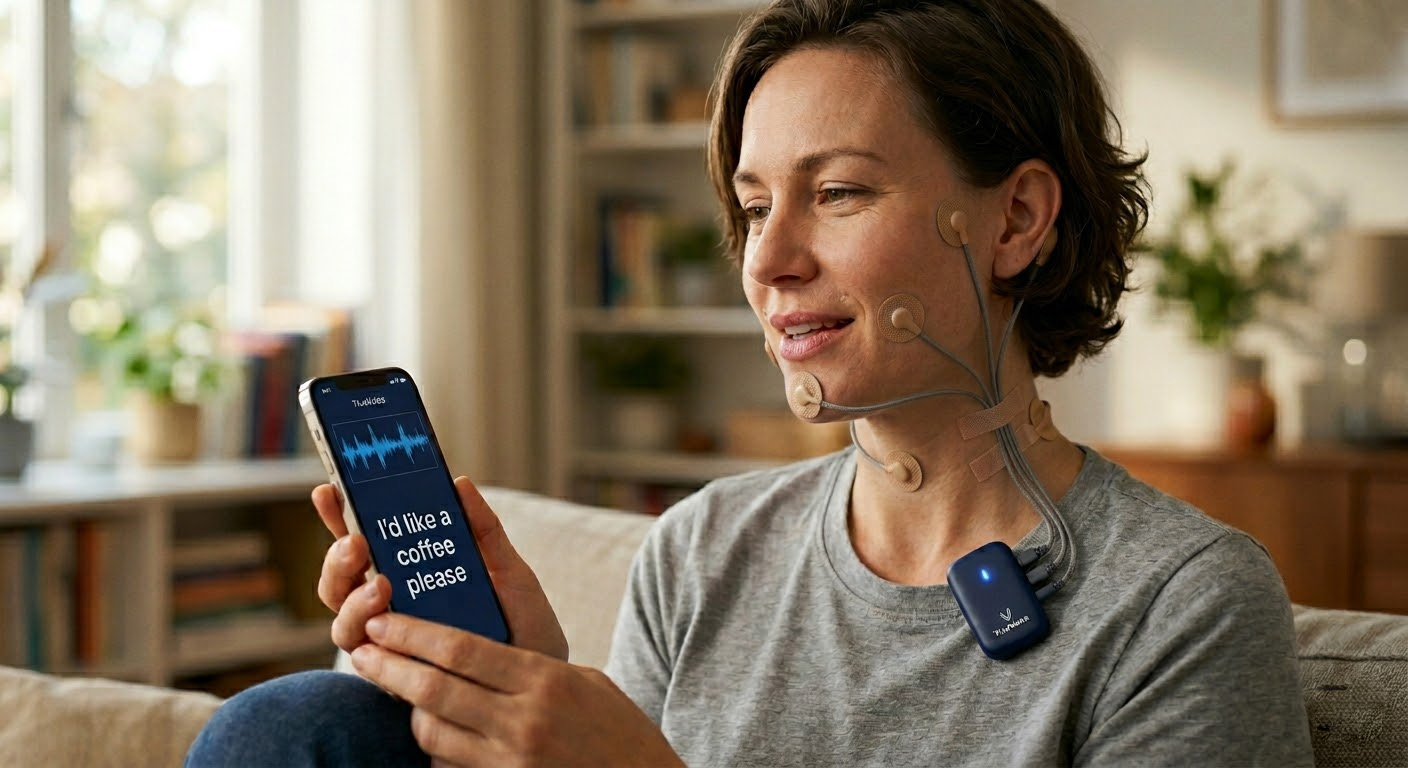
TrueVoice concept vision — skin-tone electrodes on jaw and neck, main unit clipped to collar, phone displaying synthesised speech

Concept Vision

Eight electrode patches on the jaw, cheek, and neck. The main unit clips to the collar. The phone speaks. No throat buzzer — just the person's own voice, restored.

AI-generated concept · Nano Banana Pro
"
// The Reason This Exists

Not a Founder Story

My life partner was 21 when throat cancer took her voice. What replaced it was a plastic device that buzzed when pressed to the neck. It let her be understood. It did not let her be heard — not really, not as herself.

She passed away in 2005. I'm not sharing this to tell a compelling founder story. I'm sharing it because it's the reason this project exists, and because she deserves to be the reason — not a footnote in a pitch deck.

Twenty-one years later, the technology finally exists to do this properly. TrueVoice is not a product looking for a market. It's a long-overdue answer to a problem I watched someone I loved face alone.

— Founder, JP Media R&D Lab · Nova Scotia, Canada
// Standing on Peer-Reviewed Shoulders

The Research That Made This Possible

TrueVoice is not guesswork. Every architectural decision is grounded in published academic research. Here are the foundational papers informing our hardware and AI design.

Primary · Sensors, 2025

Electrode Setup for EMG-Based Silent Speech Interfaces: A Pilot Study

University of the Basque Country

The most directly applicable paper to TrueVoice. Specifically targeting laryngectomized speakers, this study identified that a minimum of 8 bipolar electrode channels are required for phoneme-level classification — and mapped the exact muscles to target.

Key Findings We Implemented

8 channels minimum — 3-channel designs are insufficient
Target muscles: Digastric, Masseter, Zygomaticus Major, Risorius, Depressor Anguli Oris, Levator Labii Superioris, Depressor Labii Superioris, Stylohyoid
Post-laryngectomy patients can still produce articulatory EMG
Secondary · IEEE Trans. Instrum. Meas., 2023

Silent Speech Recognition via sEMG Using Few Electrode Sites Under High-Density Array Guidance

IEEE Transactions on Instrumentation & Measurement

Validated that CNN architectures with transfer learning can achieve significant accuracy improvements on limited-channel EMG data. Demonstrated that 8 optimally-placed channels can approximate full-array performance.

Key Findings We Implemented

60–85% phoneme accuracy in controlled lab conditions with 8ch
Transfer learning baseline → per-user fine-tune architecture
2kHz sampling rate validated for speech articulator EMG
Context · Comparable Research

Meta Reality Labs — Wrist-Based EMG

Meta has invested heavily in wrist-based EMG for AR/VR gesture control. However, wrist EMG captures gross hand motor signals — a far simpler problem than speech articulation. Jaw and neck EMG is more complex and more informative. TrueVoice operates in harder, richer territory.

Gap in Market

No EMG-Based Silent Speech Device Exists Commercially

As of 2025, there is no commercially available EMG silent speech interface on the market. No product exists that combines 8-channel EMG acquisition with on-device feature extraction, BLE streaming, and personal voice cloning — at a price accessible outside of academic grants. TrueVoice is building that product.

// Signal Chain

From Muscle to Voice

A five-stage pipeline transforms invisible muscle movement into audible, personalized speech.

01

8-Channel EMG Acquisition

Eight Ag/AgCl bipolar electrode pairs adhere to the jaw, cheek, and neck at muscle sites identified by the 2025 Basque Country research. Each pair feeds raw differential EMG into the ADS1298 — a 24-bit medical-grade analog front end sampling simultaneously at 2,000 samples/second per channel.

ADS1298 · 24-bit ADC 8 simultaneous channels DRL noise cancellation Gain=12 · 2kSPS
02

On-Device Feature Extraction

The ESP32-S3 reads the ADS1298 over SPI and computes log-Mel spectrogram features in real time — compressing the raw 256 kbps stream down to approximately 10–20 kbps of feature vectors for stable BLE transmission.

ESP32-S3 · 240MHz dual-core Log-Mel features BLE 5.0 streaming 20–30ms latency
03

Gating + Phoneme Classification

On the phone, a binary gating model distinguishes intentional speech from eating or swallowing artifacts. Only when speech is detected does the primary CNN/Transformer phoneme classifier activate.

Gating model (binary) CNN phoneme classifier CoreML / TF Lite Per-user fine-tuning
04

Language Model Correction

Raw phoneme sequences are resolved by a lightweight on-device language model that uses context to select the most likely intended word before passing to synthesis.

On-device inference Context-aware correction 10–30ms latency
05

Personal Voice Synthesis

The phone speaks the output using the user's personal voice clone — recorded before voice loss. End-to-end latency approximately 300–400ms. Their words. Their voice.

Personal voice clone On-device TTS ~300ms end-to-end iOS + Android
// Under the Hood

Phase 1 Hardware Architecture

A 50×50mm 4-layer PCB designed to medical-grade signal acquisition standards.

Analog Front End

Texas Instruments ADS1298

Channels 8 simultaneous
Resolution 24-bit delta-sigma
Sample Rate 2,000 SPS / ch
PGA Gain 12× (configurable)
Interface SPI @ 20MHz
Microcontroller

ESP32-S3-WROOM-1-N16R8

Cores 2× Xtensa LX7
Clock 240 MHz
Memory 16MB Flash / 8MB PSRAM
Wireless BLE 5.0 · Pre-certified
BLE Latency < 30ms
PCB & Power

JLC3313 4-Layer Stack

Board Size 50 × 50mm
Layers 4 (ENIG finish)
Battery 1200mAh LiPo
Runtime ~6–8hrs active
Charging USB-C · 500mA
8-Channel Electrode Placement · Per Basque Country 2025 Study
CH1
Digastric (Ant.)
CH2
Dep. Anguli Oris
CH3
Risorius
CH4
Lev. Labii Sup.
CH5
Masseter
CH6
Zygomaticus Maj.
CH7
Dep. Labii Inf.
CH8
Stylohyoid
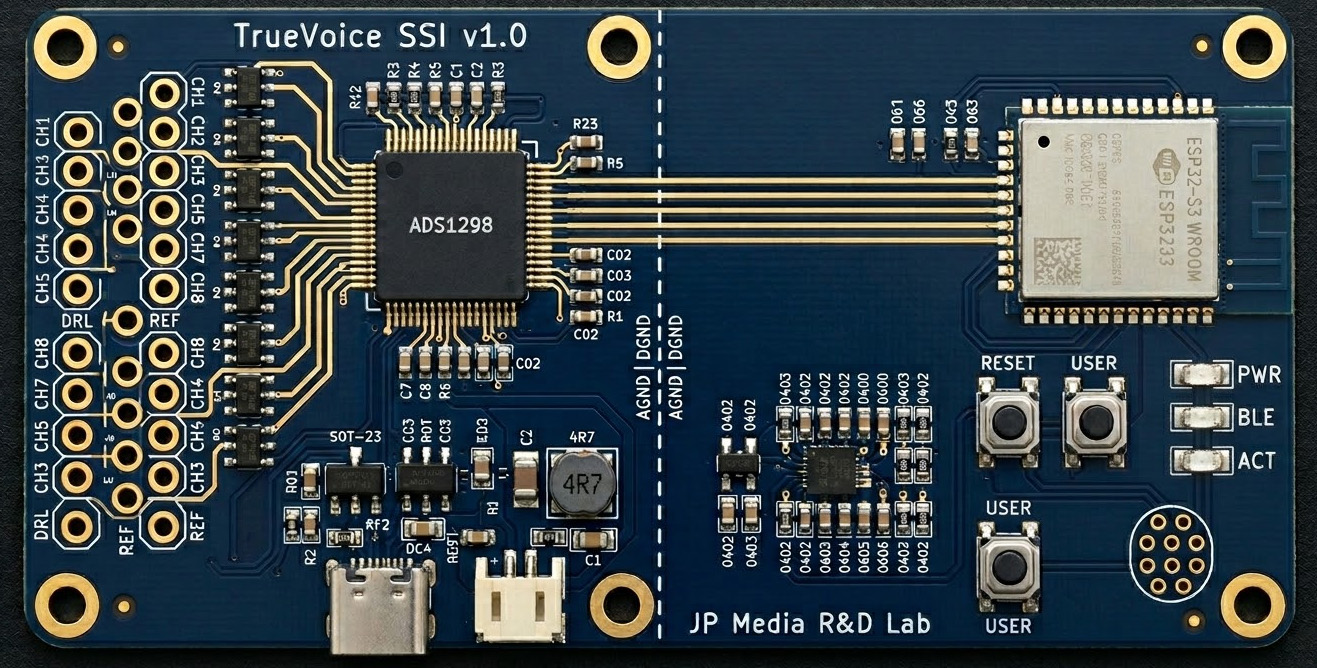
TrueVoice SSI v1.0 PCB concept

Hardware Concept

TrueVoice SSI v1.0 — 50×50mm · 4-layer JLC3313 · ADS1298 + ESP32-S3 · ENIG finish

AI-generated concept · Nano Banana Pro
// Build Status

Where We Are Now

Full Hardware Architecture — Defined & Audited

Complete schematic, BOM, netlist, placement grid, and routing playbook verified through multiple independent audit passes.

KiCad EDA Setup — Complete

Footprint library, DRC custom rules, netclasses, layer stackup, and placement coordinates locked for KiCad 8.

PCB Routing — In Progress

Laying copper in KiCad. EMG differential pairs, DRL/REF routing, SPI corridor, and power planes in sequence.

04

Gerber Export & JLCPCB Fabrication

JLC3313 controlled-impedance stackup. First physical prototype boards.

05

Firmware Bring-Up & ADS1298 Validation

Register readback, lead-off detection, raw EMG signal capture and validation.

06

AI Model Training & Phone App

EMG dataset collection, phoneme classifier training, voice cloning integration, iOS/Android deployment.

// Open Collaboration

Help Restore Someone's Voice

TrueVoice is an open-architecture project. We are actively looking for collaboration with speech-language pathologists, oncology teams, accessibility advocates, embedded engineers, and AI researchers.

Most critically — we are looking for patients who have lost or are losing their voice and would be willing to help train and validate the system. Without real users, the AI cannot learn. Your participation is the most important contribution possible.

Reach Out to the Lab